18 июля 2013 г.

20 July 1969 - Moon Day in the USA

Moon Day commemorates the day man first walked on the moon in 1969.
The Apollo Space program, begun by President John F. Kennedy, was created to put the first man on the moon. Apollo 11 fulfilled that dream, carrying astronauts Neil Armstrong, Michael Collins, and Edwin Aldrin, Jr. What an amazing and historic event it was!

On July 16, 1969, Apollo 11 was launched from Cape Kennedy Space Center atop a huge Saturn V rocket. On July 20, 1969, the Lunar Module, nicknamed the "Eagle", touched down on the surface of the moon at Tranquility Base. Upon landing, Apollo 11 Commander Neil Armstrong reported "The Eagle Has Landed". A few hours later, Neil Armstrong, stepped off of the Eagle's ladder, placed one foot upon the moon's surface and proclaimed: "That's one small step for a man, one giant leap for mankind".

18 July - the day of murder of Righteous martyr Elizabeth Feodorovna

Ella was the second child in her family. The children were raised in the traditions of old England. Their life went by a strict regiment set by the mother. The children's clothing and food was very simple. The three older daughters did housework all by themselves. they cleaned up the rooms, made their beds, kept the fire in the fireplace.
Later Elizabeth Feodorovna would say: "at home I was taught everything"


The parents of Elizabeth Feodorovna - the Great Herzogg of Hesse-Darmstadt Louis IV and princess Alice - the daughter of Queen Victoria, used most of their money for charity purposes.

And the children often went with their mother to hospitals, orphanages, houses for invalids. With them they brought many flowers, which they took to the sick. The mother tried hard to notice the development of each of her children's talents, and to raise them in accordance with the foundation of Christian commandments, to love their neighbors, and especially the suffering.

15 июля 2013 г.

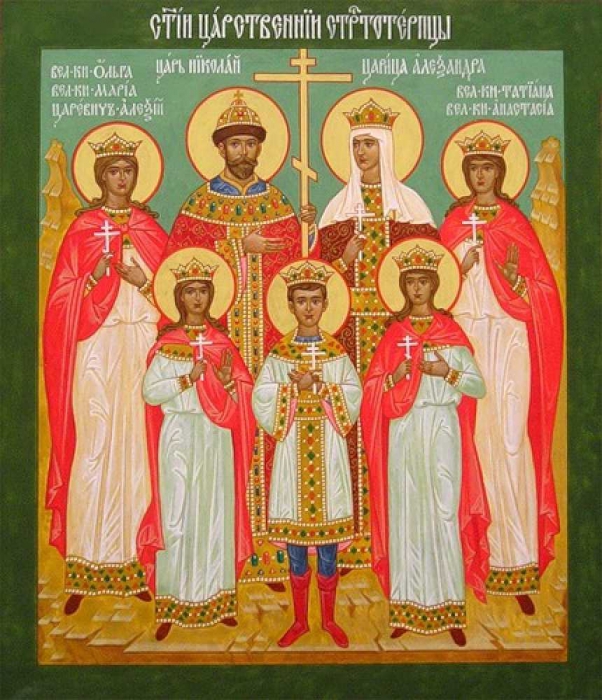
17 July 1918 - The Execution of Tsar Nicholas II and his family

 The mounting pressures of World War I, combined with years of injustice, toppled the rule of Tsar Nicholas II in March 1917. Forced to abdicate, he was replaced by a Provisional Government committed to continuing the war.
Increasing losses at the front and the fear of a German advance on Moscow eroded what little support remained for the war and undermined the Provisional Government's authority. Capitalizing on this situation, the Germans secretly transported the exiled Vladimir Lenin in a sealed train from Switzerland to Russia in the hope he would enflame the turmoil. German expectations were realized on the night of November 6-7 when Lenin led the Bolsheviks in a successful attempt to grab the reigns of power in St. Petersburg. Anti-Bolshevik forces (the White Russians) immediately took up arms to oust the Communist regime and Russia was plunged into a brutal civil war. The following March the Communist regime signed a treaty with the Germans ending Russia's participation in World War I.
Against this backdrop of political chaos, the Tsar and his family were initially kept as prisoners near St. Petersburg and then transported beyond the Ural Mountains finally ending up in the town of Ekaterinburg in the Spring of 1918. The seven members of the imperial family and their small retinue were confined to the house of a successful local merchant, N. N. Ipatiev, which had been commandeered by the Bolshevik's for this purpose.
By mid-July a Czech contingent of the White Army was approaching Ekaterinburg and the sounds of gun fire could be heard in the distance by the royal prisoners and their Bolshevik captors. The arrival of their potential liberators sealed the fate of the Tsar and his family.
During the early morning hours of July 17 the Tsar, his wife, children and servants were herded into the cellar of their prison house and executed.
"We must shoot them all tonight."

14 июля 2013 г.

15 July - St. Swithin's Day in the UK

St. Swithin's Day is 15 July, a day on which people watch the weather for tradition says that whatever the weather is like on St. Swithin's Day, it will continue so for the next forty days.
There is a weather-rhyme is well known throughout the British Isles since Elizabethan times. 

'St. Swithin's day if thou dost rain 
For forty days it will remain 
St. Swithin's day if thou be fair 
For forty days 'twill rain nae mair.'
dost = does
thou = you
nae mair = no more.

Who was St. Swithin?
St. Swithin (or more properly, Swithun) was a Saxon Bishop of Winchester. He was born in the kingdom of Wessex and educated in its capital, Winchester. He was famous for charitable gifts and building churches.

13 июля 2013 г.

14 July 1789 - Bastille Day (The Fall of the Bastille)

Storming of Bastille on July 14, 1789
by Jean-Pierre Houë
Bastille Day commemorates modern France and French democracy. Bastille Day is a French holiday. But, you can celebrate it, too.

Bastille Day symbolizes the end of the constitutional monarchy, and the beginning of the democratic republic of France. To Frenchmen, Bastille Day is viewed as their liberation.

Bastille Day is actually called Fete de la Federation. In France, it is a holiday that is celebrated with military parades.

12 июля 2013 г.

13 July - Council of Twelve Apostles holiday in Russia

An apostle, from Classical Greek ἀπόστολος (apóstolos), meaning "one who is sent away", is a messenger and ambassador. The purpose of such "sending away" is to convey messages, and thus "messenger" is a common alternative translation.
Today we name "apostles" the disciples of Jesus Christ as well as Paul who was called after Jesus Christ's crucifixion, His Resurrection and Ascension.
In New Gospel we read, "When Jesus had called the Twelve together, he gave them power and authority to drive out all demons and to cure diseases,  and he sent them out to proclaim the kingdom of God and to heal the sick. He told them: “Take nothing for the journey—no staff, no bag, no bread, no money, no extra shirt.  Whatever house you enter, stay there until you leave that town. If people do not welcome you, leave their town and shake the dust off your feet as a testimony against them.” So they set out and went from village to village, proclaiming the good news and healing people everywhere." (Luke 9, 1-6)
And they were ordinary people who heard Him and followed Him. Source in Russian

13 July - Mikhail Pugovkin, a Soviet/Russian comic actor, was born


Mikhail Pugovkin was a Russian comedian known for his roles in Svadba v Malinovke - Wedding in Malinovka - (1967) and Иван Васильевич меняет профессию - John Vasilyevich changes his profession - (1973).


John Vasilyevich changes his profession
Mikhail Ivanovich Pugon'kin on July 13, 1923, in the village of Rameshki, Kostroma province, Russia, Soviet Union. At age 13, Pugovkin moved to Moscow. He had a dream of being an actor, but his first job was that of a metal worker at a Moscow factory. During the season of 1938-39, Pugovkin, still an amateur actor, gained attention among professionals due to his highly unusual talent as comedian. In 1940 he joined the troupe of Moscow Drama under directorship of Fedor Kaverin.

In 1941 Pugovkin made his film debut in Delo Artamonovykh (1941) by director Grigori Roshal. Then he was drafted in the Red Army, and fought in the front-lines against the Nazis during the Second World War. He served in a military intelligence unit and was decorated for his courage. In 1942, during a clandestine operation, Pugovkin was wounded in the leg and was hospitalized. His wound was so serious that a surgeon insisted on amputation, which Pugovkin declined, because he wanted to continue his acting career. He spent several months recuperating, and eventually re-gained his mobility and became able to work as an actor again.

Когда нет слов...

:) :( ;) :D :-/ :x :P :-* =(( :-O X( :7 B-) #:-S :(( :)) =)) :-B :-c :)] ~X( :-h I-) =D7 @-) :-w 7:P 2):) :!! \m/ :-q :-bd ^#(^